

Richiedere un preventivo
Invia un feedback
Notizia
 Casa / Notizia / Notizie del settore / How to Tell If a Power Strip Is a Surge Protector: A Step-by-Step Check
 How to Tell If a Power Strip Is a Surge Protector: A Step-by-Step Check
 2026.06.22
 Notizie del settore
Why the Confusion Is So Common
Pick up a basic power strip and a surge protector at any electronics retailer and set them side by side. The housings look identical. The outlet spacing is the same. Both have an on/off switch. The price difference may be only a few dollars. This near-perfect visual similarity is the root of a problem that costs consumers millions in damaged electronics every year.
The confusion is made worse by packaging language. Products described as offering "protection," "safety switch," or "overload protection" are not necessarily surge protectors. Those terms refer to circuit-breaker functions that cut power when too many devices draw too much current at once — a real safety benefit, but one that has nothing to do with voltage spikes. For a closer look at whether most power strips include surge protection by default, the answer is no — and the reasons matter. Across the full range of EU and KC standard power strips with overload protection, overload protection and surge suppression are separate systems that may or may not appear together in the same product.
The four-step verification process below applies whether you are assessing a product before purchase or checking something already installed in your home or office.
Step 1 — Check the Label and Packaging
The single most reliable starting point is the label printed on the device itself or on the original packaging. Manufacturers of genuine surge protectors are required to identify their products as such, and the language used is specific.
Look for any of the following terms printed on the strip or its box: "surge protector," "surge suppressor," "surge protection device," or "transient voltage surge suppressor" (TVSS). These are not interchangeable with "power strip," "multi-outlet strip," or "extension cord" — if the product uses only those descriptions, it does not offer surge protection.
The second thing to look for is a joule rating. Joules are the unit used to express how much surge energy a device can absorb before its protection degrades. A joule rating only appears on products that contain surge-suppression components; a basic power strip has no energy-absorbing element and therefore no joule value to declare. If you find a joule figure — 600J, 1,080J, 2,000J — the product contains surge protection. If no joule rating appears anywhere on the device or packaging, treat the product as a basic power strip regardless of any other marketing language.
As a general benchmark: ratings below 600 joules are suitable only for low-value equipment. For computers, televisions, and home office setups, 1,000 joules should be considered the practical minimum, and 2,000 joules or above is appropriate for high-value or frequently used electronics.
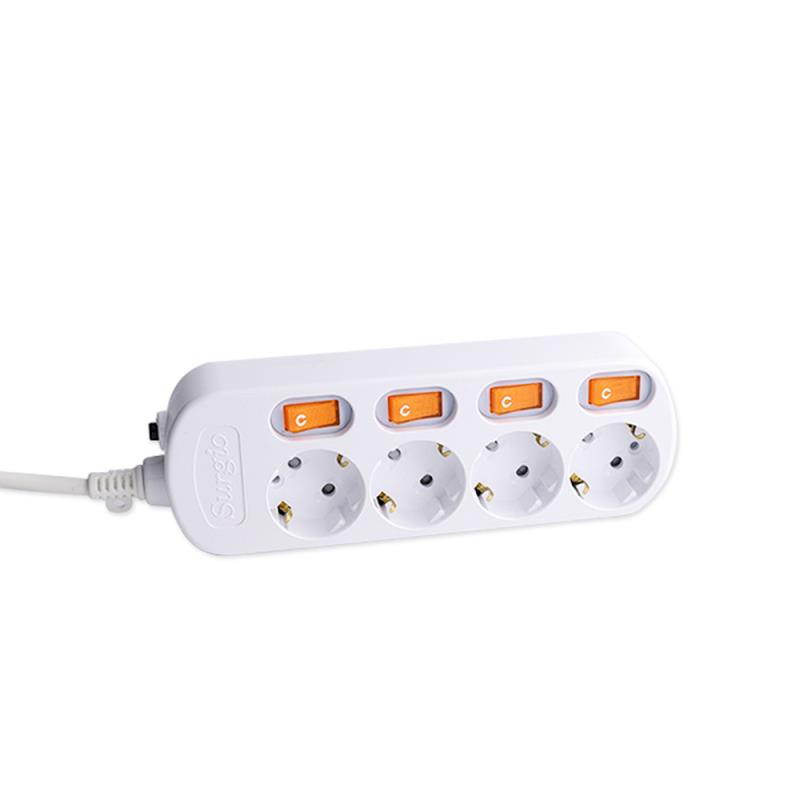
Step 2 — Look for the "Protected" Indicator Light
Many surge protectors include a small LED indicator, typically labeled "Protected," "Surge Protection," or simply marked in green. This light does more than confirm that the device is a surge protector — it tells you whether the protection circuitry is still functional right now.
Surge protection in most consumer devices is delivered by a component called a Metal Oxide Varistor (MOV). The MOV absorbs excess voltage during a spike event, but in doing so it is gradually consumed. A surge protector that has absorbed several large events may still deliver power normally to everything plugged into it while offering zero protection — because the MOV has been fully depleted. The indicator light monitors this state.
| Indicator Light State | What It Means | Action Required |
|---|---|---|
| Green / illuminated | Surge protection is active and functional | None — protection is working |
| Off (strip still powers devices) | MOV has been exhausted; no surge protection remains | Replace the unit immediately |
| No indicator light present | Cannot confirm protection status visually | Verify via label, joule rating, and certification mark |
The absence of an indicator light does not mean the product lacks surge protection. Some models, particularly older or lower-cost surge protectors, omit this feature entirely. In those cases, the remaining steps in this checklist become more important.
Step 3 — Verify the Certification Mark
Independent safety certification is the most objective confirmation that a product has been tested and confirmed to meet defined surge suppression performance standards. A manufacturer's own labeling can be misleading; a third-party certification mark cannot.
The key certifications to look for depend on the market the product is intended for:
- UL 1449 (North America): The standard specifically covering surge protective devices. A product listed to UL 1449 has been tested to confirm it meets defined surge suppression thresholds. The listing mark will appear on the device along with the words "surge protection device." Basic power strips may carry a UL listing mark as well — but they will be listed to a different standard (UL 1363 for relocatable power taps) and will not include the words "surge protection device." For detailed guidance on what this certification covers, UL's official guidance on distinguishing power strips from surge protectors provides a clear breakdown.
- EN 61643-11 (European Union): The European equivalent standard for surge protective devices. Products certified to this standard and carrying a CE mark specifically for surge protection have been independently evaluated. Note that CE marking alone is not sufficient confirmation — CE is a broad self-declaration mark and can appear on basic power strips. The specific EN 61643-11 reference must be present.
- KC Certification (South Korea): Products intended for the Korean market carrying KC certification for surge protection have been evaluated under Korean electrical safety standards. As with CE, the specific category of certification matters — KC marking alone does not confirm surge suppression.
If the product carries no independent certification mark at all, the risk of both missing surge protection and substandard construction rises significantly. Uncertified products are a false economy regardless of price.
Step 4 — Read the Voltage Protection Rating
Once you have confirmed that a product is a genuine surge protector, two additional specifications determine how effective that protection actually is: the Voltage Protection Rating (VPR) and the joule rating reviewed in Step 1.
The Voltage Protection Rating (sometimes called clamping voltage) describes the voltage level at which the surge protector activates and begins diverting excess energy. Lower numbers are better. A VPR of 330V means the MOV engages when voltage climbs above 330V, limiting what reaches your connected devices to that threshold. A VPR of 600V means the surge has already reached a potentially damaging level before the MOV responds.
The standard benchmark to look for is 330V or below. Products rated at 400V offer acceptable protection for most residential use. Anything above 500V provides significantly reduced protection and should be avoided for sensitive electronics.
For devices with built-in electronics — including power strips with built-in USB charging ports — the internal charging circuitry itself is sensitive to voltage irregularities, making the VPR specification particularly relevant. A lower clamping voltage protects both the devices plugged in and the strip's own components.
| Specification | Basic Power Strip | Surge Protector |
|---|---|---|
| Joule rating | Not present | Present (look for 1,000J+) |
| Voltage Protection Rating | Not applicable | 330V or below (optimal) |
| "Protected" indicator light | Absent | Present on quality models |
| UL 1449 / EN 61643-11 listing | Absent | Present |
| MOV component inside | No | Yes |
| Overload / circuit breaker | Sometimes | Often included alongside surge protection |
Common Mistakes When Identifying Surge Protectors
Even buyers who know what to look for fall into a few recurring traps. These are the three most common misidentifications.
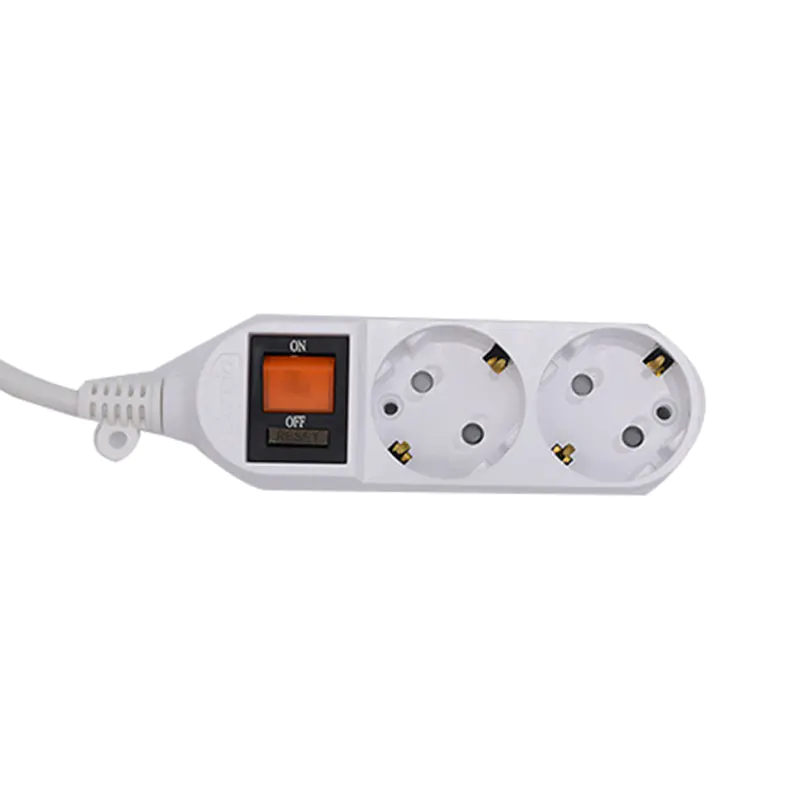
Mistake 1: Assuming an on/off switch means surge protection. A power switch — whether a single master switch or individual switches per outlet — controls whether electricity flows to connected sockets. It has no effect on voltage spikes that arrive while the outlet is switched on. Power strips with individual per-outlet switches are excellent for managing device power independently and reducing phantom load, but switching capability is entirely separate from surge suppression. A switched product is not a protected one unless the joule rating and certification confirm it.
Mistake 2: Treating overload protection as equivalent to surge protection. A built-in circuit breaker trips when the combined current draw across all outlets exceeds the strip's rated amperage — it prevents overheating and reduces fire risk from overloaded circuits. This responds to sustained overcurrent measured in amps, not to the brief voltage spikes measured in microseconds that define an electrical surge. The two systems operate on different principles and address different failure modes. A strip can have an excellent circuit breaker and zero surge suppression.
Mistake 3: Assuming a higher price confirms surge protection. Pricing in the power strip category does not reliably correlate with surge protection capability. Premium strips may offer more outlets, longer cords, better build quality, or USB charging ports while including no surge protection whatsoever. Equally, a modestly priced product from a certified manufacturer may offer genuine, well-specified surge suppression. Price is not a proxy for protection — only the label, joule rating, and certification mark are.
When to Replace a Surge Protector You Already Own
Identifying a surge protector correctly at the point of purchase is only half the task. MOV-based protection degrades over time, and a unit that was certified and fully functional when purchased may offer little remaining protection years later.
The standard guidance from electrical safety authorities is to replace surge protectors every three to five years under typical residential use. In environments with frequent power fluctuations — areas with unstable grid supply, older building wiring, or regular electrical storms — replacement should be considered after two to three years regardless of whether the indicator light has failed.
Replace a surge protector immediately if any of the following apply: the "Protected" indicator light is no longer illuminated while the strip is powered; the strip has experienced a confirmed severe surge event such as a nearby lightning strike; the cord or housing shows physical damage; or the strip is more than five years old and the protection history is unknown.
One final point worth understanding: a surge protector that has exhausted its MOV will continue to function as a basic power strip. Devices will charge and power normally. The only thing missing is the protection — which is precisely the failure mode that makes aging surge protectors so deceptive. Understanding which appliances you should avoid plugging into a basic power strip helps clarify the real stakes of using an unprotected or depleted strip for sensitive electronics.
 Eng
Eng
Prodotti
CHI SIAMO
Informazioni di contatto.
- +86-18758062352
- +86-0571-64701616
- [email protected]
- No. 7, Xinqu Road, Xin’anjiang Street, Jiande, Hangzhou, Zhejiang, Cina

Copyright © 2023 Hangzhou Newmany Electronics Co., Ltd. Tutti i diritti riservati. Produttore di strip di energia in Cina| Login

 TOP
TOP